Saturday, 25 May 2013

What Katie Ate by Katie Quinn Davies


Publisher: HarperCollins
ISBN: 9780007458592
Format: Hardback
Pages: 304
Genre: Non-Fiction, Cookery
Publication Date: February 28, 2013


SYNOPSIS

This extraordinary début cookbook from award-winning Irish photographer and home cook Katie Quinn Davies features over 100 simple, seasonal recipes. Katie offers much-loved classics and mouth-watering fresh dishes for breakfast, lunch, dinner, baking and desserts, drinks and gatherings. Featuring Katie's gorgeous photos throughout, this enchanting cookbook is a feast for the eyes as well as the palate.

REVIEW

Cookbooks have become a particular weakness for me over the last 6 years. I've seen my collection rapidly grow from a few basic student cookbooks to well over 3 shelves worth. And while admittedly they are mostly unused, they are much loved.

I think I just miss food. I was fortunate to grow up in Toronto, a fantastic multicultural city that provides an amazing diversity of world cuisines to sample. I'm also quite lucky to have my father who is a wonderful chef and whose food I could never hope to reproduce myself. So it's not a surprise that some of my earliest and fondest memories are sitting down and enjoying a tasty meal. To me cookbooks are not only just great reference tools for honing culinary skills, but can also serve as literary keys to unlock treasure troves of sensory associated memories.

This year I promised myself that instead of staring longingly at photos of foods I want to eat, I would make good use out of all my cookbooks and try to become more of an intuitive chef rather than a strict recipe-only amateur. It'll be a long time before I develop enough of a knowledge base to instinctively combine random things into tasty meals, but I think this cookbook is a good place to start.

What Katie Ate is a hard book to resist. Quite simply, it's one of the most beautiful cookbooks I've seen. The food photography found within its pages feels rustic, yet highly polished in its framing and lighting, but most importantly, every photograph makes you passionately want to cook the mirroring recipe.
I'm ashamed to admit that I've bought a plethora of recipe books purely on how well designed and attractive they are rather than asking myself the oh so practical question "Will I ever use this?".  With space becoming a new unwanted and incessant issue, Katie's book had to pass my first test to see if it would remain on my shelf. The first thing I do when I have to decide whether or not I should buy a cookbook is to mark the number of recipes that I would like to cook, that have realistic ingredients that I can find easily and don't involve kitchen contraptions I've never heard of and most likely will never buy. You'd be surprised how many cookbooks I had to grudgingly put back into stock because there were only a small handful of recipes I could mark within their hundreds of pages.

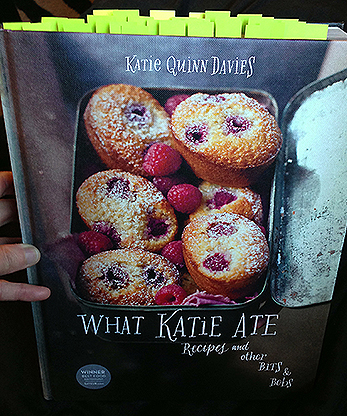
I set off with my trusty pack of post-its and bookmarked well over 40 recipes before running out.  I debated on buying another pack of sticker notes to finish off the rest of the book so I could quote a precise number for this review, but decided in the end that it might be a tad too obsessive. Even for me. We'll just say that What Katie Ate passed the first part of my criteria with flying colours.

The first recipe I tried was the Mushroom and Bacon Risotto with Poached Egg. A dangerous starting choice. I haven't poached an egg in over a decade and in the past I have gotten bored and frustrated with the constant stirring/pouring of liquid which has resulted in some spectacularly crunchy risottos.

Mushroom and Bacon Risotto with Poached Egg (page 168)
As a quick side note, this recipe calls for Cavolo Nero and my local grocers didn't seem to stock it. I'd never heard of it before so for other cooking novices like me, Cavolo Nero (also known as Black Cabbage, Tuscan Kale or Lacinato) is a dark green leafy Italian cabbage that can be substituted with regular kale, spinach or chard. I went with the safe choice of spinach since it’s the only vegetable I actually know how to prepare and cook properly out of the three.

It’s probably a good thing that this recipe doesn't mention a rough cooking time and sits next to an incredibly appetizing photograph of the finished product, or I would have chosen an easier and less time consuming recipe to make. Or maybe chosen to make this on a day off with plenty of preparation time rather than attempt to squeeze this meal into a workday evening. When I finally sat down for my very late dinner, with a grumbling stomach and a starving boyfriend by my side, I was starting to wonder if all that hand numbing stirring was worth it. Oh boy, was it worth it.

It was lovely and creamy; well balanced and the addition of the poached egg is a fantastic idea. I've always found risottos to be a bit too rich and repetitive. With every spoonful having the same creamy consistency and bold flavour it can become increasingly overpowering and overwhelming with each additional bite, but the poached egg on top provides another texture and taste to break up the monotony.

The next recipe I cooked was the Lemon Chicken with Herbed Rice. By contrast, it was probably one of the worst plates of food I've ever made. Any subtlety of flavours from the herbs and seasoning was drowned out by the overpowering taste of balsamic vinegar. It may have looked pretty on a place but after two bites, I had no choice but to throw it out and order a pizza.

Lemon Chicken with Herbed Rice (page 166)
The success (or in this case the failure) of the recipe came down to the creation of the sauce. The lemon sauce consists mainly of 125 ml of Italian salad dressing combined with 80 ml of soy sauce and 180 ml of lemon juice. Katie comments that by using a shop-bought salad dressing as the base for the sauce, it gives the dish a fresh tanginess and acts as an ingenious shortcut for a quick easy meal.

I think the fault lies in the recipe’s lack of explanation of what to look out for in the readymade dressing. I've discovered that there are many variations in the ingredients that go into the different brands and the vast sea of online recipe sites have many differing ideas of what can be added to the vinaigrettes.

Since the dressing accounts for 48% of the liquid going into the sauce, the delicate balancing act needed to create a proper sticky sauce to coat the chicken rests on the flavour coming out of that bottle. It’s a risky thing to rely on amateur cook selecting something perfect. The inclusion of a short author’s passage on what goes into a traditional Italian dressing or an optional list for nervous chefs who want to forgo the shortcut and create it from scratch would have been welcomed. It’s a shame that for me this recipe relies too heavily on blind luck rather than foolproof precision. I think it could have been a lovely twist on a classic dish.

I did manage to take away something positive from cooking this recipe. The inclusion of chopped spring onions and herbs to the cooked rice is a simple inspired idea to add an extra dimension to an otherwise bland accompaniment. It never even occurred to me to add salt and pepper to plain rice before and I've been eating it for most of my life! That revelation alone was worth the small chicken sacrifice made to the refuse gods.
Fettuccine with Prawns, Cream and Sun-Dried Tomatoes (Page 142)

The tie-breaking dish was a creamy fettuccine with prawns and sun-dried tomatoes. A great pasta dish that’s simple to make. I would recommend chopping the sun-dried tomatoes into finer pieces than the suggested strips if you don’t want to end up with a mouth full of strong chewy tomatoes, but other than that minor compliant it was a very tasty dinner.

And I couldn't review this cookbook without baking the raspberry friands displayed on the front cover. After all, it’s the image that first caught my eye and made me lust over the book obsessively for several weeks. This dessert piqued my interest not only because of the attention stealing photo, but because despite having a lot of baking books, I've never heard of them before. Friands are small French cakes that are quite popular in Australia and New Zealand. They’re usually baked in special oval shaped moulds to give them their distinctive shaped, but it’s difficult to find here in the UK. Online shops do carry them, but I found it works really well in a standard cupcake tin. Just reduce the baking time to about 20 minutes instead of 25-30 to account for the smaller size.

Raspberry Friands (page 240) 
They taste absolutely AMAZING. The one downside I found about the recipe is that these cakes should all be eaten on the day that they’re baked. The fresh raspberries lose their shape and texture the following day and spread into the sponge. The day old friands weren't unpleasant to eat, but just knowing how tasty they were previously made it a bit of a let-down. Ideally, they should be devoured straight out of the oven while still warm and inviting. The cake sponge is light and moist with a hint of sweetness and the sharp acidity of raspberries makes for a fantastic combination. The small batch I left in the staff room quickly disappeared and I have now promised to bake some more for everyone who missed out the first time. Rave reviews all round and a new addition to my favourite recipes collection.

I hope Katie won’t mind me posting the recipe for it here, since it’s available on her blog. It’s the one I would recommend everyone try since it’s surprisingly simple to make and incredibly moreish.

Raspberry Friands

http://www.whatkatieate.com/recipes/raspberry-friands/


Ingredients

• 10 free-range egg whites
• 300 g unsalted butter, melted
• 175 g ground almond
• 370 g icing sugar, sifted, plus extra for dusting
• 100 g plain flour, sifted
• 2 x 125 g punnets raspberries, plus extra for serving

Method

1. Preheat the oven to 180 ̊C (fan), 200 ̊C, gas mark 6.
2. Lightly grease 18 holes of 2 silicone friand moulds or non-stick friand tins.
3. Whisk the egg whites for a few seconds just to lightly combine; you don’t need to whip them into peaks or anything like that.
4. Add the butter, ground almonds, icing sugar and flour and beat lightly to combine well. Pour into the prepared moulds or pans, filling each hole to just two-thirds full.
5. Place two or three raspberries on top of each friand and bake for 25–30 minutes or until a skewer inserted into the centre comes out clean and tops are lightly golden brown.
6. Dust the friands with icing sugar and serve warm, with extra fresh raspberries if you like.

Makes 16-18 friands. (made 24 friands in the cupcake tins)


Despite making one disastrous recipe, I really loved the food featured in Katie's book. The stunning food photography and charming faux rustic page layouts are addictive to flip through and I can't help picking up the book every so often to just to admire it artistically. I'm really looking forward to cooking more dishes, especially the ridiculously cute mini egg benedicts. It's a wonderful cookbook and a much appreciated belated birthday gift. 

Cookbooks are meant to be used, not merely gawked at no matter how vivid the descriptions, elaborate the illustrations or scrumptious the photographs may be. As the old adage says, the proof of the pudding is in the eating and What Katie Ate is proof that you can have a tantalizing book that is as much a feast for the stomach as it is for the eye.


Short and Sweet: The Twitter Review

Elegant and thoroughly delicious, What Katie Ate is a mouthwatering temptation that's hard to resist. 

Thursday, 9 May 2013

Beautiful Book of the Month: May

The Rime of the Modern Mariner By Nick Hayes


Published April 2011
ISBN:  9780224090254
Format: Hardback
Jonathan Cape
www.capegraphicnovels.co.uk


I know I'm late again writing my Beautiful Book of the Month article, about 4 months late to be precise, but I promise you I picked an absolute beauty for this long overdue post.

Over the years I have amassed an admirable assortment of enticing literary tomes, but even among the two bookcases designated to house my most beloved books there are a few titles that still manage to shine a little bit brighter than the rest in my eyes. My favourites among my favourites. While my shelves have seen many new additions and have undergone many bouts of shuffling, Nick Haye's The Rime of the Modern Mariner has always held its lofty position; clearly visible and easily accessible, and in my overflowing library that is the highest possible honour I can bestow upon any book.

It’s rare today to come across something so remarkably well crafted. The illustrated matte cover is combined with a luxurious wrap around cloth spine and polished off with elaborately etched silver lettering. The addition of the quirky “handwritten” typeface and whimsical wave patterned end pages add to the character of this charming illustrated novel.


Hayes uses a limited colour palette for his illustrations, sticking only to subtle hue variations of pastel blue and black. It is truly amazing to see how much detail and depth can be achieved using so few colours. I think also by restricting the range of shades, it gives the piece a sense of uniformity and forces the viewer to pay closer attention to how the images interact on the page with one another.

Each page is laid out with impeccable precision, creating a visual language all of its own that flows naturally and fluidly from page to page, mirroring the natural rhythm that emerges from the poem’s rhyme. No two pages are arranged in quite the same way.

But beneath this stunning visual feast, there lurks a compelling and haunting moral fable. This beautiful graphic novel reinvents Samuel Taylor Coleridge's longest and arguably his most famous poem, The Rime of the Ancient Mariner. First published in 1798, the original tale relates the experiences of a weary sailor who has returned from a long sea voyage. He stops a man who is on the way to a wedding ceremony and begins to weave a harrowing story of sin and reparation spurred by the senseless killing of an albatross.

It’s a tremendous challenge to rework a classic, especially since the work will inevitably be compared to its reference material no matter how drastically altered or original it may be. Nick Hayes takes on the enormous task of constructing his own original verse for his narrative tale and has created something that is not only lyrically melodic, but visually striking.

The Rime of the Modern Mariner is a cautionary tale of environmental disaster created by humankind’s excessive consumption and our indifference to the consequences on the world around us. By updating the synopsis of the story, Hayes devises something that is more accessible than the original; more relevant to our time and in a way, conveys a stronger message that grows more necessary to impart with each passing year.  

There are several clever twists made to the initial tale. Hayes modernises Coleridge's wedding guest, a bright young man inexplicably transfixed by the sailor’s every word, into a jaded divorced office-worker who listens half-heartedly to the tale to pass time on his lunch break. Instead of imparting a sense of a hard lesson won, learned and imparted to a new generation, Hayes protagonist is left astonished and sitting alone as the city dweller declares the tale as an amusing “nursery rhyme” and goes back to his life with an untainted conscience. While it is a down hearted ending, it does ask the viewer the uncomfortable question of how much the novel has affected them. Will they too go back to their previous wasteful ways? Or perceive the world in a new light and make some amends for their past negligence?  

The Rime of the Modern Mariner is a provocative piece of work that proves that literary graphic novels can impress, inflame and inspire people just as well as their unillustrated counterparts.

I admire Random House and Jonathan Cape’s commendable attention to detail in the design of this visual novel. They’re one of my favourite publishers, not only because of their continued support for indie comic artists, but also for the exceptional quality and respectful care they put into creating suitable formats tailored for each unique art style and story.
Last year, I reviewed another graphic novel, Building Stories by Chris Ware (also published by Jonathan Cape) and I found myself continuously impressed with the production quality. I was surprised that such a gorgeous product was printed by a large publisher since it seemed like such an indulgent risk to produce. I honestly believe that there aren't many publishers willing to undertake such a tremendous task to create a book that not only does justice to the artwork found inside its pages, but can be considered a piece of art itself.

Wednesday, 1 May 2013

An Unexpected Interlude...

I want to apologize for my sudden and unexpected hiatus from this blog. I didn't mean to suddenly stop writing without any warning, but I have found myself struggling with some personal issues over the last few months that had momentarily caused me to lose enthusiasm for most things.

I find writing for this website puts me in the odd position of composing a blog that is not about my personal life or experiences, but about my opinions on books I've recently read, the book industry in general and the important role that books play in my day to day routine. The thing is, this is a personal project and my writing style has never been particularly objective. I've never been able to detach myself from my emotions when constructing reviews which I don't think is necessarily a bad thing. If a book doesn't evoke enough of an emotional response then any commentary regarding it becomes bland. Without passion, whether it is positive or negative, words become monotonous.

But what to do when my real life bleeds into my entries? I have rambled on about my quirky obsession with books ahead of some of my book reviews before, but nothing that wasn't somewhat relevant to the topic and always light-hearted. I'm sorry, but I feel the need to explain my long absence, even if only as a record for myself and no one else. It just feels too jarring to suddenly come back with a random cheery "I'm back!" post or flood the blog with my growing folder of backlogged critiques. So bear with me, while I get this out of my system and I promise I won't do this often or hopefully ever again.          

Looking back at my first post, I mentioned that one of the reasons I decided to start this website was because I realized during my shop's refit that I needed to make some time for my own projects and that my life was being consumed by work.  What I failed to mention then is the reason I decided on a blog as my creative outlet was because I injured my dominant hand quite badly and couldn't indulge in my other major passion: drawing. That was about 10 months ago and it has never really healed. Over the past months, I was let go from my physiotherapist under the mutual knowledge that my wrist was still damaged and a few weeks after that I discovered a small tremor in my hand.  It's a hard concept to wrap your head around that something that is a constant source of pleasure and pride in your life may not be possible to do any more. At least, not with the same ease or skill. It's a hard fact to swallow. I could feel myself unravelling; become unmade. Those events left me in a dazed stupor and I'm only just starting to snap out of it. I'm hoping that my hand will improve in time or at the very least I get over the fear and let my trembling hand finally hold a pencil again.

What I found both surprising and alarming is that for the first time in my life, losing myself in a good book couldn't shake me out of my state of apathy. I've always found books to be a great form of escapism. They are the only foolproof method that I've found where I can forget for a moment that I am me and lose myself in another world, another character and just block out for a few blissful hours all my issues and worries. They are tiny pieces of sanity I keep within arms reach for emergencies and peace of mind. While I can't say that I've had a horrific childhood worthy of immortalization in the 'Painful Lives' section in biography (whose books are easily distinguished by the cover images of a sad child set against a blazing white background), I certainly didn't grow up with a normal family or under normal circumstances. I think the oddness of my childhood years is what drove me to read piles and piles of books.

I want to thank everyone who has commented about this little experiment of mine. I never thought it would have lasted this long and it hasn't been a complete disaster. I'm looking forward to writing my next few posts. I'm going to tackle reviewing my first cookbook with pictures of my hopefully triumphant attempts to create something that looks remotely like the images next to the recipes, a review of a book from someone I "sort of" know and one from someone I know very well and my first "bad" review.

I appreciate all the kind words and encouragement everyone has passed on to me, even though I don't think of myself as much of a writer. I apologize for the seriousness of this post and I hope I haven't made anyone feel awkward in its reading, but hopefully you'll stick around and everything will be all sunny again. *smiles*
   

Thursday, 24 January 2013

Beautiful Book of the Month: January

Apologies for the lateness of this post. I seem to be getting more forgetful and leaving this post later and later each month. The practical side of me is tsking myself and saying I should just skip this month and move this one to the next since February is a only a week away, but I know if I use that flimsy excuse for this month I'll use it again without guilt in the future. Without that "healthy" sense of guilt this blog wouldn't exist in the first place.

To Kill a Mockingbird By Harper Lee


Published June 2010
ISBN:  9780434020485
Format: Special Edition Clothbound Hardback
William Heinemann


An elegant celebratory clothbound edition marking the fiftieth anniversary of an unforgettable classic. My very thoughtful boyfriend bought me this wonderful book as a Christmas gift and I was absolutely thrilled when I opened my present. I left my well worn copy back in Canada and I'm glad I finally have it back in my library.

I've wanted to purchase this hardback since its initial release 2 years ago, but I always found the cover image both immensely stunning and saddening. It's hard for me not to look at it and instantly have the quote "Shoot all the blue jays you want, if you can hit ‘em, but remember it’s a sin to kill a mockingbird" pop into my head. The decorative red and black flowers and vines that weave themselves along the spine and flow onto both the front and back covers is one of my favourite touches in this design. The symbolic mockingbird is delicately silkscreened onto the fabric preserving the fine detailing work in the claws, beak and tail feathers.

There are certain books that you come across in life that not only profoundly change the way you view the world, but how you view literature and the power that a storyteller wields over readers. As a child and young teenager, I would lose myself in tales of sword swinging fantasy, chilling mysteries and goosebump inducing horrors. For countless wonderful hours, I'd wander the streets, forests, caves and dungeons of these imaginary worlds, but as much as I loved inhibiting these universes they weren't my reality; they weren't my world. Because they were so easily distinguishable, the events, the horrors and the injustice found in between the pages of these books never effected me very much. It was the way of that world, but not the ways of my own.

Mockingbird detail
That all changed during my first year of high school when the curriculum for my English class had us reading Lord of the Flies, 1984 and To Kill a Mockingbird. I never quite got over the feelings of shock, anger and shame those books invoked in me. I developed a new respect for books after reading those 3 novels. Not all books are meant as sheer entertainment, they could be used as effective tools to broaden minds and be powerful enough to change the world.      

Front Cover
This book is one that stays with you. It lingers on in your memory. It was the first book that I read that dealt with racism. I have to confess that I had lived a relatively sheltered life up to that point. I knew that racism existed, but I never had to deal with the harsh realities of it. I was fortunate to have grown up in Toronto, which is an extremely multicultural city surrounded by people from all walks of life so it hit me hard when I read about how people could form such horrible ideas about each other just by appearance.

When Atticus talks with Jem and Scout, he treats them like adults; honestly answering any questions they had about intolerance and discrimination and explaining why the world is sometimes unfair and unkind. To me, he was a literary surrogate father explaining away all the injustice in the world and while he couldn't change the way things worked magically overnight, he made others question themselves and their own misguided beliefs and that was his victory for morality and reason.

The reason I'm telling you all this personal history in this beautiful book feature is because I want to emphasize that this is not only a beautiful book because of its intricate binding or the elaborately adorned cover design, but it's also a beautifully composed narrative full of tragedy, courage and hope. There has been debate over keeping To Kill a Mockingbird as a recommended key text in schools. Some people claim that it's dated; the time period is too far removed from our current, Atticus' stance is too timid and not strong enough and that the liberal use of a harsh racial slur is uncomfortable to the sensibilities of readers today, but I disagree. The messages found in this book are timeless and are no less profound with the passage of time. If anything, the limitations of that era lends to its potency. We may seem to have come a long way, but it's always important to remember the harsh lessons that many had to suffer through to get to where we are today. It's those small building blocks, those small seeds of change planted in people's minds that will continue to improve the world that we live in. I hope that it'll continue to find a large and wide readership, because any book that has the ability to still resonate with its reader nearly two decades on, is something that needs to be preserved and passed on to future generations.      

Flower detail on cover and spine
"I wanted you to see what real courage is, instead of getting the idea that courage is a man with a gun in his hand. It's when you know you're licked before you begin but you begin anyway and you see it through no matter what. You rarely win, but sometimes you do."
- Atticus Finch

Thursday, 10 January 2013

Born Weird by Andrew Kaufman


Publisher: The Friday Project
ISBN: 9780007441402
Format: Hardback
Pages: 270
Genre: Fiction, Quirky Fiction
Publication Date: January 3, 2013

Please note that this review refers to an uncorrected advanced proof edition.


SYNOPSIS

The Weirds had always been a little bit peculiar, but not one of them suspected that they’d been cursed.

At the moment of their birth Annie Weird gave each of her five grandchildren a special power that she thought was a blessing. Richard, the oldest, would always keep safe; Abba always had hope; Lucy would never get lost and Kent could beat anyone in a fight. As for Angie, she would always forgive, instantly. But over the years these blessing turned out to be curses that ruined their lives.

Now Annie is dying and she has one last task for Angie, her favourite grandchild. Angie must gather her far-flung brothers and sisters and assemble them in her grandmother’s hospital room so that at the moment of her death, Annie can lift these curses.

And Angie has just three weeks to do it.

REVIEW

New Year’s always does strange things to me. No matter how many times I tell myself that I don’t care about doing something special on New Year’s Eve and that there’s no real significance or rational function behind all my menial preparations to start the year off “right”, I still find myself running around my flat like a mad person during the last few days of December.

While I hate myself every year for the now expected annual irrational cleaning spree, there is one tradition that I actually quite enjoy adhering to: the selection of the first book to read to start off my year.

This is of vital importance to me. I know it’s silly, but books are a huge part of my life. It doesn't exactly revolve around books (though there might be some argument for that), but books do influence and shape my ideas, passions and sometimes my current outlook on life. So choosing the first of the year means a lot to me. It sets the tone and the expectations I have for the following months.

That’s the reason why I put off reading this book for the past few weeks. As much as my fingers craved to pick up the lovely proof copy, I couldn't think of a more ideal choice that filled me with as much anticipation and excitement and there is nothing quite like the pleasure of discovering that a new book is being published by one of your favourite authors.

Andrew Kaufman’s newest novel is a blursing. Fast becoming my new favourite word, it means exactly what it sounds like; it’s both a blessing and a curse. Born Weird is a blessing because it’s 270 pages of the most enjoyable and madcap writing I've ever had the privilege to read and a curse because I very much doubt I'm going to find something I love more than this book over the next 12 months.

What I love most about the novel is how Kaufman managed to impart each sibling with a unique interpretation of his or her gift. The introductions to each character serve as whimsical side stories that explore how each individual has allowed their ‘blursing’ to dictate their life and define their peculiar personalities. I won’t spoil anything for you since a lot of the addictiveness of the story lies in the unveiling of each curse’s manifestation, but they’re ingenious and wonderfully imagined; even the ones whose outcomes are somewhat predictable.

Andrew Kaufman is an extremely gifted storyteller. I admire his ability to imbue tiny touches of the unusual to otherwise mundane, realistic settings. He gives the everyday, the commonplace occurrences that make up our daily lives, life. That little sprinkle of strange is that little bit extra that livens up what could have been an ordinary family drama into a fantastic modern day tall-tale that doesn't feel out of place or farfetched. It makes you wish you had a little bit more of that same quirkiness lurking in your life. If, like me, you feel by the end of the book that you really want some more of that same magic to brighten up your life, I recommend seeking out his brilliant novella, All My Friends Are Superheroes. It’s one of my personal favourites to read whenever I feel a bit gloomy. It’s Andrew Kaufman just weirdly being weird and weirdly doing well and I hope that never changes. *


*This last sentence may not sound right or even make much sense, but I assure you once you've read the book you will all see how exceedingly witty and clever it really is. That or how cheesy it is.

Short and Sweet: The Twitter Review

The perfect personification of peculiar, Born Weird is a charming tall-tale: Eccentric, comical and with just the right amount of heart.

Monday, 10 December 2012

Building Stories by Chris Ware


Publisher: Jonathan Cape Books
ISBN: 9780224078122
Format: Boxset containing hardbacks, paperbacks, pamplets, etc
Genre: Graphic Novel
Pages: 260
Publication Date: October 4, 2012


SYNOPSIS

In Chris Ware's own words, 'Building Stories follows the inhabitants of a three-flat Chicago apartment house: a thirty-year-old woman who has yet to find someone with whom to spend the rest of her life; a couple who wonder if they can bear each other's company for another minute; and finally an elderly woman who never married and is the building's landlady...'

The scope, the ambition, the artistry and emotional heft of this project are beyond anything even Chris Ware has achieved before.

REVIEW

This is my first real introduction to the work of Chris Ware. I've admired his previous books, especially the Acme Novelty Library series, from afar but I haven’t been brave enough to read one yet. At first glance they appear too daunting to just slip into. While lovely to look at, there is a lot of information for your retinas to process; panels and faces filled the pages from top to bottom and tiny font filled in all the remaining gaps. They always left me feeling a bit intimidated and mildly confused about how to decipher a path through the colourful mazes. To me, they seemed like mystifying logic puzzles in image form that I would one day work up the courage to work through.

Building Stories is his latest work, a graphic novel comprising of 14 distinctive printed works ranging from magazines, broadsheets, flip books and pamphlets. This unconventional 'book in a box' is the most fun and unique book format I've ever had the pleasure of coming across. When you slowly lift the lid off the container and cast your gaze over the assortment of colourful treats, it fills you with childish glee. There are papers and booklets of all sizes and shapes and it’s impossible not to feel a little excitement at the sense of wonder and discovery.

Building Stories in all it's glory...
The order in which you chose to assemble your narrative is entirely up to you. The stories are intricately connected and span over a time period of 2 to 3 decades, so there is a reading order in a sense since the passing of time is clearly visible for some characters, but each piece can be tackled in any order. In a way, I think it adds to the charm of the book. I like to imagine that if I pass this onto others they might end up following a different path from mine and may come out feeling differently about certain events or the whole book altogether if they manage to finish on a more uplifting segment than I did.

The craftsmanship behind each item and the intricate details contained in each colourful panel are some of the most impressive design work I've come across. The amount of meticulous precision, consuming passion and painstaking planning that has gone into the construction and execution of this enormous project is staggering. There’s actually no need to read through the text contained in most of the booklets, it’s an absolute marvel to look at. It somehow manages to defy logic and appear to be both densely packed without looking cluttered and rigid yet strangely chaotic all at the same time.

Building Stories has left me feeling divided. While I think that it’s a masterpiece and an instant classic for its genre, I'm not sure how much I truly enjoyed the stories it contained. It’s odd for me to absolute adore the aesthetics, but slightly loathe the unrelenting bleakness that surrounds the multiple storylines explored in this collection. Surprisingly, this is not a condemning statement to make about this compilation. Chris Ware has written himself on the back of the box that “this book is sure to sympathize with the crushing sense of life wasted, opportunities missed and creative dreams dashed”, so readers are warned in advance of the general sense of melancholy that characterizes this visual novel.


Most of my discomfort lies in the voyeuristic nature of this piece of work. It’s similar to the uncomfortable feeling you get living in a flat with paper thin walls and involuntarily overhearing a loud argument from your neighbours next door, only a thousand times worse. In this case, not only are you listening in to conversations and arguments about a range of personal and highly sensitive topics, but you’re also watching the whole thing in vivid detail, like an invisible occupant in the room perceiving the devastating effects of those string of insults and the instant remorse that flickers across the faces of characters who come to the realization that they can’t take back the harmful words.

Ware’s natural ability to empathize with his characters is remarkable. He gives voice to the insecurities and sometimes awkward socially unacceptable ideas and thoughts that crosses all of our minds, whether we like to admit it or not. All this is handled with a deft touch that allows us to sympathize with the characters without making them despicable. There were many moments where I cringed at certain storylines, but I had to stop myself and ask was it really because it’s so truly a horrid thought to have about another person or was it because there’s a small part of myself that recognized I would be a hypocrite for damning the character when I myself could easily have had a similar thought?

My favourite piece is the large blue accordion style booklet. On one side, it shows a meticulously drafted layout of each floor of the brownstone apartment with skilfully added touches of life like the addition of dirty laundry on the floor, stubborn old crumbs hidden behind couches and a small collection of dried leaves blown against the front doors. Those little details, so cleverly thought out, serve to create an inviting environment that our eyes can roam and explore out of what normally would be a very sterile and pristine architectural diagram devoid of occupants and colour.

I remember looking at the open fallen book on the floor of one of the bedrooms and thinking how badly I wanted to pick that up because it’ll crack the spine if it’s left like that (Yes, I'm one of THOSE people). Oh the horror! I think the brilliance of that piece is that even though the images contain no people, we still can find something familiar to identify with.

In contrast, the other side is brimming with small vibrantly coloured comics portraying the hidden thoughts and interactions between the residents of the building. Consisting of 4 panels, each with a fixed view of the front of the brownstone building in one season, it serves both as a backdrop for these little episodes and gives a sense of passing time. This booklet doesn't drive the story along like some of the others do, but that’s why I found it refreshing. It wasn't an emotionally charged episode or a bitter-sweet look into the past, it’s just a cleverly constructed and amusing glimpse into the lives of these characters.

While I admire Chris Ware for not shying away from the difficult and often mishandled topics of isolation, depression and the paralysing effect of losing yourself in thoughts of the past, I constantly found myself hoping against hope that the next booklet I picked up would contain a happier outcome for the protagonists.

In a previous post, I talked about picture books being an unappreciated and underrated form of storytelling. Comics and graphic novels are another genre that is greatly ignored in many literary circles. Hopefully, the addition of two graphic novels to this year’s Costa Award shortlist will go a long way to help the image that graphic novels are respectable forms of pictorial literature.

I think many individuals don’t know how to approach reading a graphic novel and that can be a bit intimidating or off putting. There are a few people that I know personally who hold the opinion that graphic novels aren't a valid form of literature because they consist mainly of images and sometimes sparse use of text. I don’t think they’re giving them a fair chance. Graphic novels require a different approach to reading than that of a normal novel. Traditional books rely on our ability to associate the words on a page with our own experiences; to use our own imagination to conjure up every single item described in the book from the features of a character to the ominous shadows lurking in the cobbled streets found in the setting. With graphic novels, there’s less of a need for that, the images for the most part are provided there for you, but that doesn't mean there is less there for you to “read”.

Visual interpretation is needed to read the expressions on character faces and the subtle body language that instinctively shapes the course of most our social interactions. The slumping of shoulders, raising of eyebrows, the pursing of lips; these are all familiar sights in our day to day lives that help us to read the moods and intentions of the people around us. Instead of being utterly dependant on the author’s words and descriptions, we have to rely on our own ability to identify the signs hinted at by the artist in the splashes of colour and deliberate scribbles of ink. Chris Ware describes it as “the weird process of reading pictures, not just looking at them.” As we “experience the world as adults; we don’t really “see” any more after a certain age, we spend our time naming and categorizing and identifying and figuring how everything all fits together.” This reliance on our sense of sight and interpretation of images is what sets it uniquely apart from other formats.

It’s hard to give a proper rating or even a general recommendation to strangers for this collection. I can say without fear that this is a work of genius and many reviewers are already justifiably proclaiming this project as Chris Ware’s magnum opus, but I can’t say that it will hold universal appeal to everyone who picks it up. It provides a unique reading experience like no other that I've come across and that’s well worth the exploration since there is no guarantee that anything will come along that will provide the same sensation. I've opened the box over a dozen of times to pull out pieces to examine while I was writing this review and the novelty of opening up this huge box full of tiny books still hasn't worn off.

There are a lot of people who will be instantly put off by the seriousness of the issues tackled and the downbeat tone and that’s perfectly understandable, but to those of you that decide to take the chance and embark on the journey, I recommend sticking with it to the end. It’s deeply affecting, offering a lasting impression of ups and downs of living a modern life.

There’s no real conclusion to the multiple storylines in Building Stories; no happy endings for its inhabitants, but that’s the point. It’s a depiction of life in its rawest form: full of regret, haunting memories, failed dreams, unsaid desires, fleeting happiness, lingering sadness and flickers of hope. Giving these characters endings aren't necessary, their lives are still in motion; their fates undetermined. What we are left with instead are our reflections on our own lives and the loud, clear message to go out and live them.


Short and Sweet: The Twitter Review

A decade in the making, Building Stories is an ingenuous work of beauty and quality. A truly unique reading experience that shouldn't be missed.

Saturday, 1 December 2012

Beautiful Book of the Month: December

The Hobbit By J.R.R. Tolkien


Published November 2012
ISBN:  9780007487301
Format: Special Edition Clothbound Hardback
HarperCollins
www.harpercollins.co.uk


I put off buying a copy of The Hobbit months ago, because I wanted something special. Something that will last for years. After all, if you're going to buy a classic why wouldn't you want something that will look beautiful on the shelf and periodically tempt you back to the lovely story within its pages?

Part of my obsessive enthusiasm for "beautiful books" is the fact that they are books that demand attention; they refuse to be ignored. With every fleeting glance towards the bookshelves, these extraordinary books stand out and coax me to come closer, to run my fingers gently over their covers and dare me to open their pages and read what's within.

No matter how tall or time sensitive my "To Read" pile grows, there’s always that nagging knowledge that some new shiny proof or book release that will inevitably push some books further from my mental priority list and lower and lower in that teetering pile. In the worse cases, they are moved to another stack of teetering books located in my bedroom with an even later promised read by date dustily associated with them. Heaven forbid they end up in the dark no man’s land that is the cramped space under my bed. I'm too scared at the prospect of hunting down a hidden gem in that poorly constructed labyrinth of lost reading material. It always conjures up an image of me being found 2 weeks later buried under a massive paper avalanche...or never being found at all.


In contrast, there’s an unspoken understanding exchanged and renewed each morning as I pass by my cherished bookcase that houses my special editions. that first initial spark of enthusiasm; that feeling of anticipation and excitement you get when picking up a new book; it never fades away in time with these books like it does with my other reading piles. I may read dozens or even hundreds of stories before I eventually pluck one of the enticing tomes off the shelf, but I know, without a doubt, that I will inevitably visit each of their worlds.

That’s the main reason why I took my time selecting an edition of The Hobbit. I didn't want a cheap throwaway paperback to read as quickly as possible before the upcoming film release. I'm already aware that the story is fantastic and to honour both it and my fond childhood memories, it had to be something deserving and desirable.

I was going to cave in and buy this edition of The Hobbit, when by chance I came across a new listing for this absolutely stunning hardback. Stunned is the perfect word to describe my reaction to seeing this lovely book. As I stood for a few seconds starring somewhat dumbfounded at the screen image, it slowly seeped into my pretty book occupied brain that it was absolutely perfect. Just what I always wanted and was waiting that extra bit for. It may sound a bit melodramatic, but that’s how it felt at that moment. Nothing is worse than the feeling you get when you finally settle for something, think you’re happy with it and suddenly the next day there’s that perfect item you were looking for, the one you gave up believing even existed, staring you right in the face. So am I excused for doing a little mental happy dance when I finally purchased this? There may have been a little discreet cover stroking and whispering of “My Precious” in a secluded corner of the shop as well. That may not be as excusable…

This collector’s edition is being advertised as a special film tie-in hardback with a design “inspired by The Hobbit: An Unexpected Journey”, but I'm happy that HarperCollins decided not to go the normal route of using either a promotional movie still or the official film poster image for the cover. Instead, we are presented with a modern, yet timeless illustrative scene of Mirkwood forest, complete with a delicate splattering of butterflies hovering above its towering trees.

“There is nothing like looking, if you want to find something. You certainly usually find something, if you look, but it is not always quite the something you were after.”
                         ― J.R.R. Tolkien, The Hobbit

Patience is not a virtue that I’m blessed with. I’m a notorious compulsive buyer of books; both the state of my flat and bank account can attest to that, but in this case I’m extremely glad that I decided to extend my search for the perfect edition. Not only did I end up with an unexpected surprise that will lead me on an unexpected journey, but I couldn’t have hoped for a more wonderful choice to guide me there and back again. 

Saturday, 17 November 2012

Beautiful Book of the Month: November

Alice's Adventures in Wonderland 

By Lewis Carroll & Illustrated by Robert Ingpen


Published August 2009
ISBN:  9781840119688
Templar Publishing
www.templarco.co.uk


After quickly scanning through my numerous bookshelves and piles before writing this post, I've roughly counted at least 10 different editions of the Alice's Adventures in Wonderland that I own so far and that’s not counting the numerous adaptations and reinterpretations that I have quietly amassed over the years.

While there is a small part of me that realizes that having so many multiple copies of the same book is incredibly impractical, both economically and spatially, I can’t help myself. There is a lure to this book that is incredibly hard for me to resist.

The stories that resonate with us are usually the ones from our childhood; the ones that sparked our first initial love of reading. Alice in Wonderland was the first book that fully captured my imagination. The first to conjure up imagery so exciting, so vivid and so ridiculous that I knew I wanted to be a part of it. It was the first fantasy universe that I wanted to escape into and first world that I truly wished with all my heart existed somewhere in real life.  From the very first moment Alice tumbled down that rabbit hole, I fell with her and I never wanted to wake up from the dream.

"Oh dear! Oh dear! I shall be too late!"
I have to remind myself that I'm not actually reviewing the quality of the story, but the quality of the actual physical book for this review. It’s hard not to get carried away by enthusiasm and just say “READ IT ALREADY!” to those that haven’t yet. It’s an absolute classic. I normally avoid brandishing the label “classic” to a book I'm trying to encourage others to read, mostly because to some it conjures up images of dusty old tombs that they either avoid like the plague or feel obligated to own on their shelves, but never intend to read. But this is a classic in the truest sense of the meaning. A 19th century reviewer, Sir Walter Besant said it best when he wrote that Alice's Adventures in Wonderland "was a book of that extremely rare kind which will belong to all the generations to come until the language becomes obsolete".  It a book that is meant to be read, to be enjoyed and it’s endearing and enduring story still evokes a sense of wonder and excitement with every additional reading. There’s always something new to discover in Wonderland.

While this may be blasphemous to many Alice collectors out there, I must admit that this is my favourite edition. Lewis Carroll’s wonderfully surreal tale is beautifully illustrated in this hardback edition. As much as I love the original illustrations by Sir John Tenniel, Robert Ingpen’s drawings just bring the world alive for me.

What I love the most about the artwork is the attention to the fine details. An astonishing amount of care has gone into each image; nothing suffers from even a hint of neglect.  Every element, from the individual strands of hair on Alice’s head to the slightly chipped and worn shell of the Mock Turtle, has been lovingly rendered in exquisite detail.  Flawlessly accurate but never rigid, the realism of Ingpen’s work adds depth and believability without detracting from the entertaining nonsense that is the heart and soul of the story.
The Mad Hatter Curiouser and Curiouser Alice embossed on cover
The Tea Party: Where I first pondered "Why is a raven is like a writing desk?"

Not only are the pictures in this edition elegantly and painstakingly drawn, but it’s also by far the most richly illustrated version I've come across. There are over 70 enchanting images to marvel and linger over. As an aspiring artist myself, I can’t help but be in awe of Ingpen’s sketches; so wonderfully textured with every pencil mark visible.    

Why is it always harder to write about the things you love? Is it because criticism comes much more naturally to us, or is it because no combination of words seems to do the subject matter justice? When I first toyed with the idea of creating a “Beautiful Book of the Month” feature, Alice instantly popped in my mind as an obvious first choice, but I just couldn't figure out what to say.  Months later and I'm still not convinced I've said the right things or nearly enough.

This is the book that I enthusiastically run from one far corner of the store to the next just to place in a customer’s hand. It’s one of the books that give me a warm happy glow inside whenever I manage to sell a copy to a fellow book lover. Not because it’s an extra sale for our shop, but because I’d like to imagine that this book will be a much loved and cherished addition to someone’s library. Just as it is in mine.


Other wonderful hardback classics in this series illustrated by Robert Ingpen
Adventures of Tom Sawyer
Jungle Book
The Night Before Christmas
Peter Pan and Wendy
The Secret Garden
Treasure Island
Wind in the Willows
Wonderful Wizard of Oz
9781402767623
9781402782848
9781402781827
9781402728686
9781402778728
9781402775451
9781402782831
9781402775468

Sunday, 11 November 2012

The Horologicon by Mark Forsyth


Publisher: Icon Books Ltd
ISBN: 9781848314153
Format: Hardback
Pages: 258
Genre: Non-Fiction, Humour, Reference
Publication Date: November 1, 2012


SYNOPSIS

The Horologicon (or book of hours) gives you the most extraordinary words in the English language, arranged according to the hour of the day when you really need them.

From Mark Forsyth, author of the bestselling The Etymologicon, this is a book of weird words for familiar situations.  From ante-jentacular to snudge by way of quafftide and wamblecropt, at last you can say, with utter accuracy, exactly what you mean.

REVIEW

One of my secret, well soon to be not so secret, insecurities is my perceived lack of an extensive vocabulary.  While I know that there are very few people that can claim complete mastery of the English language, I do feel more often than not that I can articulate myself much better in the written form rather than spoken. Is it because I get somewhat overly excited at times and my mouth runs miles away from my thoughts? Or hopefully, it’s the opposite and my mouth is frantically trying to catch up to my rampant thoughts, stumbling over words and leaving a trail of half constructed and only semi-coherent sentences in its wake. Most people that know me quite well will describe me at best as a rambler; a person who lacks organization in her speech or writing, but hopefully I’m an interesting one.

I would love to have the linguistic ability to say exactly what I want clearly and concisely when needed.  It may sound geeky, but that would be the equivalent of granting me a much coveted superpower. Forget flying circles around my enemies, I would love the skill and knowledge base to talk circles around them instead.  Give me Socrates over Superman any day.  

So now make way for my newly discovered modern day hero, Mark Forsyth: demystifier of obscure words, phrases, rhetoric and prose and my personal harbinger of lexical efficiency. His newest book, The Horologicon, or Book of Hours, is a brilliantly crafted collection of strange and wonderful words appropriate to each hour of the day. And that is exactly why this book is pure genius.

By assigning a certain hour and the common activities associated with that time of day to a single chapter and placing you, the reader, firmly as the main character of his narrative, Forsyth has already cunningly set the ground work for making all these seemingly daunting and strange words identifiable. He injects unfamiliar words seamlessly into familiar activities without jarring the reader away from the engrossing and intentionally educational depiction of their life.      

How many times have you thought “There HAS to be a word for that?” when going about a commonplace routine or daily activity? Ever seen some delicious morsel of food on a friend’s plate that you suddenly wish you had ordered yourself? Stared longingly after it as they painstakingly devour the object of your desire one slow bite at a time and with it the tiny slivers of hope you had of obtaining a sample. There’s a word for that!
Groke: To stare wistfully at somebody while they are eating in the hope that they will give you some of their food.
Maybe knowing exactly the word to describe your anguish will soften the blow for you when it happens next time. Probably not, but it gives you something else to focus on rather than that diminishing dessert.

While I can’t even begin to comprehend how to pronounce this next word, I still think it’s utterly brilliant and perfectly describes my entire time at University in one succinct word.
Shturmovshchina: The practice of working frantically just before a deadline, having not done anything for the last month.
The Horologicon draws from an interesting compilation of source material ranging from the expected; the Oxford English dictionary, to the obscure; Dictionary of Obsolete and Provincial English, to the downright amusing; the Anatomy of Melancholy.  My personal favourite is The Vocabulary of East Anglia; An Attempt to Record the Vulgar Tongue of the Twin Sister Counties, Norfolk and Suffolk as It Existed In the Last Years of the Eighteenth Century, and Still Exists by Reverend Robert Forby, possibly because I’ve lived in Norwich now for about 6 years and there are still an alarming number of strange words I get introduced to every year. Keith Skipper has made a living from compiling several volumes solely on the oddities of the traditional Norfolk language, much to the delight of both tourists and locals.

What is surprising is that despite the endless stream of new terms thrown at you in rapid succession, the book remains an easily accessible and addictive read that rivals any fiction page-turner. It's been a while since I've last encountered a non fiction book that I've thoroughly enjoyed reading from beginning to end.  An absolute joy to read and to top it off I actually learned a useful thing or two from it. Mark Forsyth’s writing is witty and informative without ever succumbing to sounding smug or conceited. He’s charismatic, intelligent and inventive, but you never once hate him for it. Well, maybe a little. As much as I admire him as a writer, I can’t help but be envious of his ability to turn a phrase.
“It is for the words too beautiful to love long, too amusing to be taken seriously, too precise to become common, too vulgar to survive in polite society, or too poetic to thrive in this age of prose. They are a beautiful troupe hidden away in dusty dictionaries… They are the lost words, the great secrets of old civilisations that can still be useful to us today.”
A perfect companion to your daily routine, The Horologicon provides intrigue to even the most minuscule and mundane of life’s little chores. So embark on this linguistic journey to shed a new perspective on your everyday activities, rescue a new found favourite word from obscurity and then go forth and unleash your new found linguistic prowess on the unsuspecting masses. Your life and your vocabulary will be richer for it.


Short and Sweet: The Twitter Review

Exceedingly clever and endlessly entertaining. Filled with weird and wonderful forgotten words, The Horologicon is a rare reference book that begs to be read cover to cover in one sitting.

Friday, 19 October 2012

Beautiful Books of the Month: October

Now that the end of October is fast approaching, I've decided to make good on a posted promise made a few optimistic weeks back.  What happened you ask?  Did I run out of pretty books to post about already?  Never.  If anything, it's always a struggle to figure out which book to pick next.

I don't want the 'Beautiful Book of the Month' to be purely about special hardback editions of established books or reissued paperback cover designs.  There will be plenty of those anyway because I usually can't resist buying them, but this is meant to be a celebration and exploration of truly remarkable books from all genres and topics.  I have a wide variety of interests and I want that reflected in this blog and in these posts.  

I love books about everything and anything, so it'll be an interesting challenge to see if my eclectic tastes work well on this blog or if it'll just end up a confusing jumble of random stuff.  Much like how things are usually organized in my head. 

For the sharp-eyed readers that may have noticed the slight variation in this month's post title, that is not a typo.  One reason for delay, other than my tendency towards procrastination, was that I wanted to include a book that wasn't released quite yet and I couldn't post about the other two without including the third since they make such a lovely set.

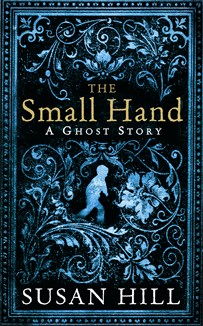
Dolly, The Small Hand & The Woman in Black 

By Susan Hill


Published by Profile Books

Three fantastic hardback ghost stories just in time for Hallowe'en!

This is slightly shameful for me to admit to since I've been a bookseller for about 13 odd years now (both odd in the sense that I think it's about that long and odd that I'm even admitting to a fact that ages me quite a bit), but I haven't read any of Susan Hill's extensive back list before deciding to pick up The Woman in Black to read before seeing the film adaptation.  Like many other book lovers, I couldn't bring myself to watch the film before reading the book.  After all, the book is almost always better than the film.  What better excuse to buy the adorably small and exquisitely lush hardback edition I had my eye on for the last few months?  Better yet, why not also purchase the matching copy of The Small Hand that somehow I talked myself out of buying 2 years ago because my strong desire for it was based solely on the pretty cover?

While I would never fully endorse judging or choosing a book by its cover, since one of my favourite books has a rather horrific cover image, surprisingly enough over the past year I've been pleasantly surprised that buying some random books purely on their aesthetic appeal hasn't steered me wrong.  I've read some fantastic fiction this year thanks to clever eye-catching designs.  Because of the overwhelming competition between new releases, the constant threat of ebooks and the rapidly shrinking shelf space in bookshops, publishers have realized the importance of giving a bit of extra care and attention to titles that they truly believe in.  Customers do notice that extra effort whether they are conscious of it or not.  If you're presented with a table of similar looking objects that are basically built in the same fashion and there is a single object that stands out; one that seems to have been crafted differently, wouldn't you want to know why someone chose to do that?  What made that other object distinctive enough to warrant special attention?
October 2012
ISBN: 9781846685743
September 2010
ISBN:  9781846682360
September 2011
ISBN:  9781846685620   
The above three do exactly that.  They inspire curiosity about their contents, lure you in with their beauty and fill you with desire for ownership.  All those feelings stirred before you even reach down to pick up the book to read the blurb on the back cover.  Oh those clever and crafty publishers get me with that all the time.

Not only are Susan Hill's charming miniature hardbacks a visual feast for the eyes, but they are a real treat to touch.  The book jackets are created using slightly heavier paper stock with the cover design embossed on top giving the novellas a pleasing tactile feel.

Detail of Woman in Black Cover

They also make a wonderful gift set for any book lover or horror enthusiast.  With Hallowe'en  and Christmas just around the corner, there isn't a better time to give a love one the grisly gift of chills, thrills and ghastly kills.  Just suggest reading with the lights on.  

  © Blogger templates Romantico by Ourblogtemplates.com 2008

Back to TOP